
Care Logs That Prevent ER Surprises and Medication Errors
Learn what to log (doses, symptoms, timing, context) so co-parents and caregivers stay aligned—and when to escalate to avoid preventable ER visits.
Why “tiny details” break down across households—and become big risks

Most child-health mishaps between homes aren’t caused by negligence; they’re caused by missing context. A text like “gave Tylenol” rarely includes the dose, exact time, reason, or what else was tried first—creating gaps that can lead to double-dosing, ineffective treatment, or an ER visit that feels like a surprise. In coparenting, those gaps also become conflict: each household believes they’re doing the right thing, but neither has the full picture.
The most common communication failures are predictable: medication names without concentrations, symptoms without severity, and timelines without anchors (“this morning” means different things). Add multiple caregivers—grandparents, sitters, after-school pickup—and the risk multiplies. That’s why care-logs are a practical form of risk-management: they turn scattered notes into a simple, shared record of what happened and when. Done well, child-health logging supports medication-safety and child-health consistency without turning day-to-day care into a courtroom exhibit.
A parent-friendly care log checklist: what to record, when to escalate
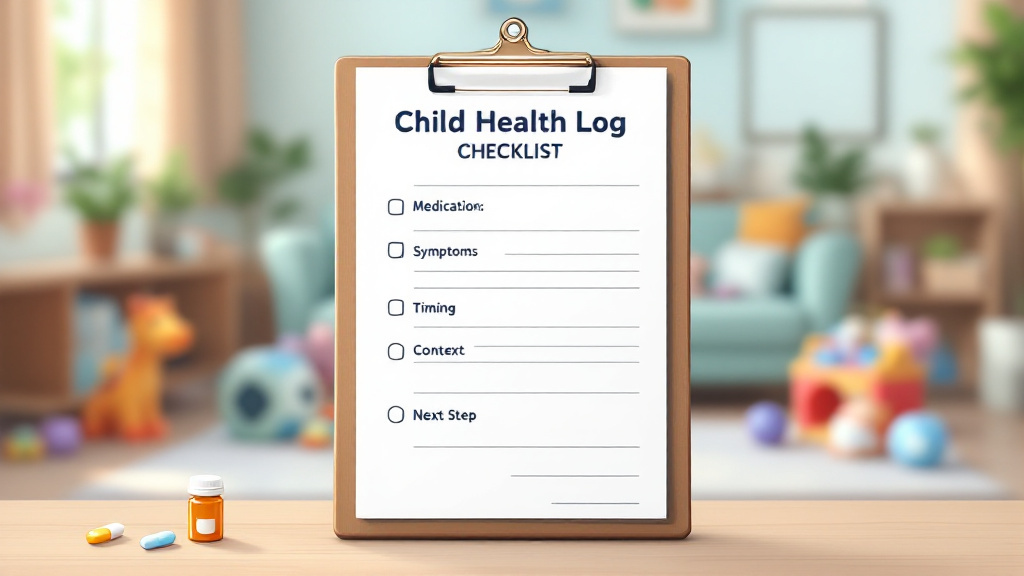
A good care log is short, factual, and repeatable. Focus on the four fields that prevent most errors: dose, symptoms, timing, and context. If you only capture these consistently, you’ll reduce guesswork for co-parents and caregivers and strengthen medication-safety during stressful moments.
Use this quick checklist for care-logs (copy/paste into your routine): - Medication: name, concentration (e.g., 160mg/5mL), dose given, method (oral/inhaler), exact time, and reason. - Symptoms: what you observed, severity (mild/moderate/severe), temperature + time, hydration/urination, sleep disruption. - Context: triggers (new food, exposure, travel), what helped/didn’t, and relevant constraints (missed meal, vomited dose). - Next step: what you’re watching for and when the next dose is allowed.
Escalate (call your pediatrician/urgent care) if symptoms rapidly worsen, breathing is affected, dehydration signs appear, or you’re unsure about dosing intervals—especially across coparenting handoffs where timing ambiguity is common.
Keep an audit trail without surveillance: shared clarity, role-based access, fewer fights

Parents often avoid detailed logs because they fear it will feel like surveillance. The goal is the opposite: reduce conflict by replacing “he said/she said” with neutral facts. An effective audit trail is simply a history of updates—who changed the pickup time, who logged the fever, and when the ibuprofen was given—so decisions are safer and discussions stay grounded. In coparenting, that’s practical risk-management, not monitoring.
Tools like HearthHandoff are built for this reality: a shared calendar for handoffs, routines for repeatable care, and care-logs that capture meds/symptoms with timestamps. The difference-maker is role-based access: a babysitter might only see today’s pickup and a printable allergy care card, while co-parents can view the full child-health timeline. That structure supports medication-safety and reduces ER surprises because everyone operates from the same, current instructions.
Keep it simple: log only what another caregiver needs to act safely, keep language factual, and agree on one source of truth. Consistency—not perfection—is what protects kids and lowers temperature in high-stakes moments.